Miller Bechtold Families

The now and then postings of the discoveries and contributions of the Miller and Bechtold families .

Friday, March 1, 2013

floyd landis 8th cousin


Floyd Landis, 2006 winner of the Tour de France

(later stripped of title for steroid use)

8th Cousin


Descendants of Hans Heinrich Landis
---------------------------
1-Hans Heinrich Landis                                   common ancestor
 +Elizabeth Hirt
|-2-Heinrich Hirt Landis                                   siblings
   +Elizabeth Naas
  |-3-Henry Naas Landis                                  1st cousin
     +Mary Garber
    |-4-Mary Landis                                          2nd cousin
       +Henrich Eichenberg
      |-5-Elizabeth Eikenberry                            3rd cousin
      |  +John Zachariah Allbaugh                    
      | |-6-Ursula Allbaugh                                 4th cousin
      | |  +Levi Miller                                      
      | | |-7-John Herman Miller                          5th cousin
      | | |  +Emma Constant
      | | | |-8-John Herman Constant Miller          6th cousin
      | | | |  +Elizabeth Ann McCaffrey
      | | | | |-9-John Herman Miller                       7th cousin
      | | | | |  +Marie Louise Bechtold
   

Monday, February 25, 2013

James Madison Authorizes Land Grant

President James Madison signs Land Grant for Peter Eikenberry in 1810, 5th Great Grandfather


The property was eventually split, but a remaining portion is the Eikenberry-Wheatville Cemetery.


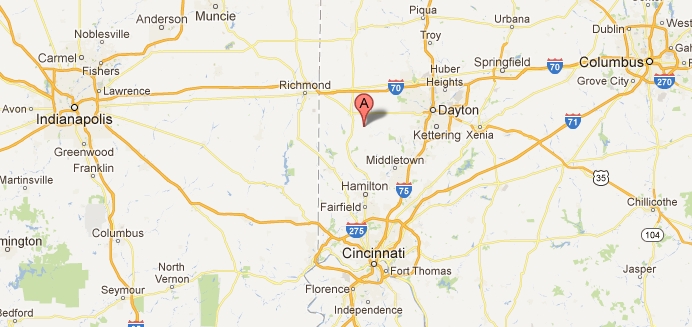
This is in Preble County, Lanier Township

1-Peter Eichenberg
 +Fronica (Faronica) Groff
|-2-Henrich Eichenberg
   +Mary Landis
  |-3-Elizabeth Eikenberry
  |  +John Zachariah Allbaugh
  | |-4-Ursula Allbaugh
  | |  +Levi Miller
  | | |-5-John Herman Miller
  | | |  +Emma Constant
  | | | |-6-John Herman Constant Miller
  | | | |  +Elizabeth Ann McCaffrey
  | | | | |-7-John Herman Miller
  | | | | |  +Marie Louise Bechtold


Friday, February 8, 2013

Philip Phillips and Honest Heberman, first African American of Ashfield

African American Couple helps raise large Phillips family

Philip, our direct ancestor took care of them in their old age, living in their own home on the property of Philip.

As noted below, they were (became?) freedmen, and members of the Congregational Church.


Biographical Sketches of Richard Ellis: The First Settler of Ashfield, Mass .... By Edward Robb Ellis


26. Site of Philip Phillips, Esq.'s house. He was a son of Thomas Phillips, the second settler in the town, and was a very intelligent and influential man. He had thirteen children—eleven of whom were sons, each one over six feet tall. Esquire Phillips was an officer in the French and Indian war of 1750. He formed his sons into a company and took great pride in exhibiting them at military trainings.
27. Residence of Mr. Samuel A. Hall. Previous to 1800 this house stood about 20 rods south of I, and was occupied by David, son of John Balding.
28. Site of a house on Bellows Hill, where Philip Phillips, Esq., once lived. Samuel Annable also lived there for a time. This is near the southwest corner of lot or Right No. 1. The old cellar-hole is yet visible.
29. Site of Heber's cabin, on the west side of Bellows Hill. Heber was a black man, said to have been brought a slave from Africa. He came to Ashfield with the Phillipses, from Easton, or the eastern part of the State. Lot or Right No. 1, where his cabin was built, was taken by him from the original Proprietors. Lots 2, 3 and 4 were on the west from this lot. Lots 7, S and 9 were on the east side of lot No. 1. That Heber was an honest and respected man is evident from the early records of the town, where he is mentioned in several places, when taxes were assessed to him, as "Heber honestman," a compliment which any person might be proud of.
...
32. Site of residence of Thomas Phillips, Sr., brother of Richard Ellis' wife, he was the second settler in the town. There is a tradition that his first house was about 50 rods south of 32, near the point marked O, and a few rods northeasterly from the fort, where there is yet to be seen a cellar hole. Nearly opposite (32) lived Thomas Phillips Jr., and after him his son, Russell Phillip*, who married Rhoda, eldest daughter of Hannah Ellis Williams (sec page 101). All of their children were born on this place.


When Thomas, Sr., settled in Ashfield, there came with him a colored man, Heber (Honestman), by name, and his wife. It is said that this colored woman was a nurse for the children, and in return for her and her husband's kindness, they were taken care of by Capt. Philip Phillips in their old age. Heber occupied a cabin at 29, just north of Capt. Phillips, a short distance above the spring. According to the old Congregational records, Heber joined that body at its formation in 1763, and died in 1768, aged 67 years.

Resting Places: Timothy Baker and Abigail (Kibbe) Baker of Pudding Fame


We have quite a few ancestors buried in Pudding Hollow Cemetery. The area, (Pudding Hollow) is named for the famous pudding contest that started with our ancestor, Abigail and her victory in what came to be a still ongoing traditional cooking contest.

Mexico Orphan's Home

Philanthropy of our GG Grandfather Levi Miller


Orphans and Widows Home 


Becomes large modern nursing residence "Timbercrest"


About 1889 Levi P. Miller, one of the early settlers of Jefferson 
township and a devout member of the German Baptist church, donated 
a site and erected a building near Mexico for an "Old Folks' and 
Orphan Children's Home," on condition that the churches of his 
denomination in what is known as the Middle District of Indiana sup- 
port the institution. When the home was first opened the old folks 
and children were kept together, but it was soon discovered that the 
playfulness of the young ones was sometimes annoying to the elder 
inmates, or that the sedateness of the old served to check the natural 
tendency of the children to amuse themselves. Other buildings were 
therefore erected so that the homes are kept separate, though under the 
same management. Orphans are received from a number of counties 
in central and northern Indiana and are well cared for at the home, at 
a charge of twenty-five cents per day for each child, until suitable 
homes can be found for them. The institution is under the control of 
a board of five directors, selected by the German Baptist church, and 
for a number of years Rev. Frank Fisher has held the position of 
superintendent. Mr. Fisher publishes a paper called The Orphan, 
which has a large circulation in Indiana and adjoining states. Although 
the home is not, strictly speaking, a charitable institution in the sense 
that it dispenses alms or aid in a general way, it has done a great work 
in finding homes for orphan children and in caring for old people, who 
might otherwise have become a charge upon the county.


MEXICO ORPHANS HOME [Mexico, Miami County]
The editor of the Macy Monitor recently visited the orphans' home at Mexico which is conducted by Rev. Frank Fisher. He was favorably impressed with the excellent management everywhere manifest. The Monitor says: "He has children there from almost everywhere, and is fortunate in finding them homes. The work that is being done there stands at the head of philanthropic enterprises and is justified from a business standpoint by the fact that it is self-supporting. The home was started by the munificence of Levi Miller, a well-to-do farmer who lives in that neighborhood, and contains sixteen acres. There has been added since, fifteen acres, which gives work to all the children during the summer. It is an ideal place for children who are left alone in the world. At present there are forty children. there."
[Rochester Sentinel, Tuesday, October 30, 1900]


NEWS OF THE DAY
The Mexico Orphans Home reports the following Fulton County children in the Home: Daisy Kershner; Alfred, Fern, Burdell and Fred Gray; and Clara and Fred White.
[Rochester Sentinel, Thursday, May 16, 1907]

MEXICO ORPHANS' HOME NOW FOR ELDERLY PEOPLE
Peru, Ind., Nov. 12 - The Mexico Welfare Home, operated by the Church of the Brethren for more than 50 years, will no longer care for orphaned children and in the future will be used only as a home for elderly persons. This change was made effective today and more than 25 orphans who were in the institution were placed in private homes in Miami and adjoining counties.
The welfare law enacted by the state legislature several years ago makes provisions for the support of homeless children. Since the law went into effect more children are being placed in private homes and there has been a large decrease in the number of applicants at orphan homes thruout the state.
The Mexico institution was founded in 1888 by Levi P. Miller, and a few years later an Old Folks Home was established there. As many as 175 children have been enrolled at the orphan Home. Miss Mary South is the present superintendent.
Rev. Frank Fisher, 85, who was superintendent of the Welfare Home for 35 years, now is a resident there, having his own cottage.
The News-Sentinel, Thursday, November 12, 1942]

Wednesday, February 6, 2013

Calvin Coolidge, 8th Cousin

Quiet President related through the Bakers

John Calvin Coolidge, Jr. (July 4, 1872 – January 5, 1933) was the 30th President of the United States (1923–1929). A Republican lawyer from Vermont, Coolidge worked his way up the ladder of Massachusetts state politics, eventually becoming governor of that state. His conduct during the Boston Police Strike of 1919 thrust him into the national spotlight and gave him a reputation as a man of decisive action. Soon after, he was elected as the 29th Vice President in 1920 and succeeded to the Presidency upon the sudden death of Warren G. Harding in 1923. Elected in his own right in 1924, he gained a reputation as a small-government conservative, and also as a man who said very little.
_________________________________________________________________________________
13. Sarah SKIPPER (1639-1710) m. Walter FAIRFIELD (1632-1723) Sarah SKIPPER (1639-1710) m. Walter FAIRFIELD (1632-1723) common ancestor
14. William FAIRFIELD (1662-1742) m. Esther GOTT Sarah Fairfield m. Thomas Abbe siblings
15. Abigail FAIRFIELD m. John PARKMAN John Warner m. Tabitha Abbe 1st cousin
16. Esther PARKMAN (1724-) m. Adam BROWN (1721-1775) Abigail Warner m. Jacob Kibbe 2nd cousin
17. Adam BROWN (1748-1837) m. Priscilla PUTNAM (1751-1837) Timothy Baker m. Abigail Kibbe 3rd cousin
18. Israel Putnam BROWN (1781-1867) m. Sally BRIGGS (1783-1869) Hollister Baker m. Rebecca Crowell 4th cousin
19. Sally BROWN (1801-1884) m. Israel C. BREWER (1797-1873) Ereda Baker m. Nathan Howes 5th cousib
20. Sarah Alameda BREWER (1823-1906) m. Calvin Galusha COOLIDGE (1815-1878) Emil Bechtold m. Jennie Ereda Howes 6th cousin
21. John Calvin COOLIDGE (1845-1926) m(1) Victoria Josephine MOOR (1846-1885) Frederick Emil Bechtold m. Marie Caroline Dresser 7th cousin
22. Calvin (John) COOLIDGE President (1872-1933) Marie Bechtold m. John Miller 8th cousin

30th President of the United States
In office
August 2, 1923 – March 4, 1929
Vice PresidentNone (1923–1925)
Charles G. Dawes (1925–1929)
Preceded byWarren G. Harding
Succeeded byHerbert Hoover
29th Vice President of the United States
In office
March 4, 1921 – August 2, 1923
PresidentWarren G. Harding
Preceded byThomas R. Marshall
Succeeded byCharles G. Dawes
48th Governor of Massachusetts
In office
January 2, 1919 – January 6, 1921
LieutenantChanning Cox
Preceded bySamuel W. McCall
Succeeded byChanning H. Cox
46th Lieutenant Governor of Massachusetts
In office
January 6, 1916 – January 2, 1919
GovernorSamuel W. McCall
Preceded byGrafton D. Cushing
Succeeded byChanning H. Cox
Personal details
BornJohn Calvin Coolidge, Jr.
July 4, 1872
Plymouth NotchVermont,United States
DiedJanuary 5, 1933 (aged 60)
NorthamptonMassachusetts,United States
Resting placePlymouth Notch Cemetery
Plymouth Notch, Vermont
Political partyRepublican
Spouse(s)Grace Goodhue
ChildrenJohn Coolidge
Calvin Coolidge, Jr.
Alma materAmherst College
ProfessionLawyer
ReligionCongregationalism
SignatureCursive signature in ink

Tuesday, February 5, 2013

Cousin Jane and King Henry

Jane Seymour, Queen Consort to King Henry VIII


Jane Seymour is the first to give an heir who lives past infancy, to King Henry VIII.

Jane Seymour our 2nd cousin, 14 removed.

Mary Clifford=Sir Philip Wentworth common ancestor
Elizabeth Wentworth=Sir Martin de la See Sir Henry Wentworth=Anne Say siblings
Joan de la See=Sir Peter Hildyard Margaret of Wentworth=Sir John Seymour 1st Cousins
Isabel Hildyard=Ralph Legard, Esq. Jane Seymour= King Henry VIII 2nd Cousins
Joan Legard=Richard Skepper

Edward Skepper=Mary Robinson
Rev. Wiliam Skepper/Skipper=Sarah Fisher
Sarah Skipper=Walter Fairfield
Sarah Fairfield=Thomas Abbe
Tabitha Abbe=John Warner
Abigail Warner=Jacob Kibbe
Abigail Kibbe=Timothy Baker
Hollister Baker=Rebecca Crowell
Erede Baker=Nathan Howes
Jennie Howes=Emil Bechtold
Frederick Emil Bechtold=Marie Caroline Dresser
Bechtold Miller, Bechtold Immel, Cary Bechtold, Bechtold Connolly


Jane Seymour (c. 1508 – 24 October 1537) was Queen of England as the third wife of King Henry VIII. She succeeded Anne Boleyn as queen consort following the latter's execution for trumped up charges of high treasonincest and adultery in May 1536. She died of postnatal complications less than two weeks after the birth of her only child, a son who reigned as Edward VI. She was the only one of Henry's wives to receive a queen's funeral, and his only consort to be buried beside him in St. George's ChapelWindsor Castle, as she was the only consort to have a male heir to survive infancy.
Jane Seymour was born in Battersea, Savernake ForestWiltshire, the daughter of Sir John Seymour and Margery Wentworth. Through her maternal grandfather, she was the great-great granddaughter of King Edward III of England through Lionel of Antwerp, 1st Duke of Clarence.[1] [our direct line] Because of this, she and King Henry VIII were fifth cousins. She was a half-second cousin to her predecessor Anne Boleyn, sharing a great-grandmother, Elizabeth Cheney.[2] Her date of birth is a matter of debate. It is usually given as 1509 or even 1510, but it has been noted that at her funeral, 29 women walked in succession.[3] Since it was customary for the attendant company to mark every year of the deceased's life in numbers, this implies she was born in 1508, or 1507 and she had not yet celebrated her 30th birthday.
She was not educated as highly as King Henry's previous wives, Catherine of Aragon and Anne Boleyn. She could read and write a little, but was much better at needlework and household management, which were considered much more necessary for women.[4] Jane's needlework was reported to be beautiful and elaborate; some of her work survived up to 1652, when it is recorded to have been given to the Seymour family. After her death, it was noted that Henry was an "enthusiastic embroiderer".[5]
She became a maid-of-honour in 1532 to Queen Catherine, but Jane may have served Catherine as early as 1527, and went on to serve Queen Anne Boleyn. The first report of Henry VIII's interest in Jane Seymour was in early 1536, sometime before the death of Catherine of Aragon.
Jane was noted to have a childlike face, as well as a modest personality.[6] According to the Imperial Ambassador Eustace Chapuys, Jane was of middling stature and very pale; he also commented that she was not of much beauty. However, John Russell stated that Jane was "the fairest of all the King's wives." [7] Polydore Vergil commented that she was "a woman of the utmost charm in both character and appearance."[8]
Marriage
The Six Wives of
Henry VIII
Catherine aragon.jpg Catherine of Aragon
Anneboleyn2.jpg Anne Boleyn
Hans Holbein d. J. 032b.jpg Jane Seymour
AnneCleves.jpg Anne of Cleves
HowardCatherine02.jpeg Catherine Howard
Catherine Parr from NPG.jpg Catherine Parr

King Henry VIII was married to Jane at the Palace of WhitehallWhitehallLondon, in the Queen's closet by Archbishop Cranmer[9] on 30 May 1536, just eleven days after Anne Boleyn's execution. As a wedding gift the King made her a grant of 104 manors in 4 countries as well as a number of forests and hunting chases, for her jointure, the income to support her during their marriage.[10] She was publicly proclaimed as queen consort on 4 June. Jane’s well-publicized sympathy for the late Queen Catherine and the Lady Mary showed her to be compassionate, and made her a popular figure with the common people and most of the courtiers.[11] She was never crowned, due to a plague in London where the coronation was to take place. Henry may have been reluctant to crown Jane before she had fulfilled her duty as a queen consort by bearing him a son and a male heir.[12]
As queen, Jane Seymour was said to be strict and formal. Her motto was "Bound to obey and serve." [12]
She was close to her female relations, Anne Stanhope (her brother's wife) and her sister, Elizabeth. Jane was also close to the Lady Lisle along with her sister-in-law the Lady Beauchamp. Jane considered Lisle's daughters as ladies-in-waiting and she left many of her possessions to Beauchamp. Jane would form a very close relationship with Mary Tudor. The lavish entertainments, gaiety, and extravagance of the Queen's household, which had reached its peak during the time of Anne Boleyn, was replaced by a strict enforcement of decorum. For example, she banned the French fashions that Anne Boleyn had introduced. Politically, Seymour appears to have been conservative.[13] Her only reported involvement in national affairs, in 1536, was when she asked for pardons for participants in the Pilgrimage of Grace. Henry is said to have rejected this, reminding her of the fate her predecessor met with when she "meddled in his affairs".[14]
Jane put forth much effort to restore Henry's first child, Princess Mary, to court and heir to the throne behind any children that Jane would have with Henry. Jane brought up the issue of Mary's restoration both before and after she became Queen. While Jane was unable to restore Mary to the line of succession, Jane was able to reconcile her with Henry.[12] Eustace Chapuys wrote to Charles V of Jane's compassion and efforts on behalf of Mary's return to favour. A letter from Mary to Jane shows that Mary was grateful to Jane. While it was Jane who first pushed for the restoration, Mary and Elizabeth were not reinstated in the succession until Henry's sixth wife, Queen Catherine Parr, convinced him to do so.[15]
In early 1537, Jane became pregnant. During her pregnancy, she developed a craving for quail, which Henry ordered for her from Calais and Flanders. During the summer, she took no public engagements and led a relatively quiet life, being attended by the royal physicians and the best midwives in the kingdom.[16] She went into confinement in September 1537 and gave birth to the coveted male heir, the future King Edward VI of England at two o'clock in the morning[17] on 12 October 1537 at Hampton Court Palace.[18]

Death

[edit]

Edward was christened on 15 October 1537, without his mother in attendance, as was the custom. Both of the King's daughters, Mary and Elizabeth, were present and carried the infant's train during the ceremony.[19] After the christening, it became clear that Jane Seymour was seriously ill.[20]
Jane Seymour's labour had been difficult, lasting two nights and three days, probably because the baby was not well positioned.[21] According to King Edward's biographer, Jennifer Loach, Jane Seymour's death may have been due to an infection from a retained placenta.
According to Alison Weir, death could have also been caused by puerperal fever due to a bacterial infection contracted during the birth or a tear in her perineum which became infected. "Within a few weeks of the death of Queen Jane there existed conflicting testimonies concerning the cause of her demise. The two official versions (carrying the approval of the crown) admitted to Englishmen at home that (1) Prince Edward had been delivered by Caesarean section after his mother had died, and to the English ambassadors and the French court that (2) the queen died of a great cold and improper foods some time after the birth of a son. The unapproved and anti-Henrician view offered another explanation and argued that (3) the queen had been 'cut before she was dead' in order to save the life of the child. This interpretation of the death of Queen Jane obviously blackened Henry's reputation as a husband and silently warned European monarchs to reject matrimonial proposals from such a self-serving king. Since Caesarean section was permitted only on dead or dying mothers, and since there was considerable evidence that the queen lived a number of days after the prince's birth, Henry's actions in 1537 would have been universally condemned." [22]
Jane Seymour died on 24 October 1537 at Hampton Court Palace at Kingston upon Thames.[13]


Tuesday, January 24, 2012

McCaffrey home are before emigration, in Poyntzpass area

Mac GAFRAIDH

Mac GAFRAIDH—VM'Gafferie, MacGaffrey, MacCaffray, MacCaffrey, MacCaffery, Caffrey, Caffery, &c.; 'son of Godfrey'; also written Mac Gofradha, Mac Cafraidh, &c.; the name of a branch of the Maguires of Fermanagh, now common in Ulster; to be distinguished from Mac Eachmharcaigh (which see), which is sometimes similarly anglicised.


The way from Poyntzpass to Newby:


The area around the Castle:


Here is a vista of the area where our McCaffrey ancestors farmed. 

St. Mary's, The Church of Ireland church (not Catholic, really) is in the foreground. As far as the eye can see in the feudal land holding of the Close family.


The castle that Carrie McCaffrey (wife of Hugh) relates is the Brumbanagher house. The descriptions of the manor Lord, Col. Maxwell Close, seems to fit, as he appears to have been a fair man with his tenants. 


The local catholic church: St. Joseph's in Poyntzpass, the locale for the 9000 acre feudal lands. This perhaps is the place to begin for church records for the McCaffrey clan.
Established 1790.
St. Joseph's Roman Catholic Church
Chapel Street
Poyntzpass
Co. Armagh
Northern Ireland
BT35 6SY


This is a link with information on the castle of Col. Maxwell Charles Close, that Carrie McCaffrey refers to in her writing.

or Wikipedia

The size of the farms upon Colonel Close’s property would not average more than ten acres; there are some as large as 150, down to five acres, but they average ten or twelve acres.


Drumbanagher House - sometimes called Drumbanagher Castle - near Poyntzpass in County Armagh, was a very large, Italianate mansion by William Playfair built ca 1837 for Lieutenant-Colonel Maxwell Close, who was the brother-in-law of 1st Lord Lurgan.


Drumbanagher, of Scottish sandstone, had a two storey centre block with higher three storey wings set at right angles to it, protruding beyond both the entrance and garden fronts. The space between the entrance front wings contained a massive, arched porte-cochére.


The roofs of the wings had eaves and bracket cornices; while the roof of the central block had a balustraded parapet. There were plain pilasters framing the downstairs windows in the ends of the wings.


Drumbanagher was designed in 1829, being one of Playfair's"grandest country houses". Following occupation by the American and British armies during the 2nd World War, it was demolished by its owner in 1951 due to the crippling expense of maintaining the property.

Writing in the Belfast Telegraph in 1962, the then owner said;  

"No mortal could have afforded to keep the castle going. So I had it demolished. Death duties, upkeep and financial difficulties meant I just had to get rid of it... It was perfectly sound and in good order when it was demolished... Now it looks like a nuclear bomb hit it. "

Today, all that remains of the great house is the "vast arched porte-cochere" (Bence-Jones), which Sir Charles Brett described as"resembling a Roman Arc de Triomphe."


The Close family still owns the Drumbanagher estate, which comprises 650 acres today - somewhat less than the 9,087 acres a hundred years ago. They run the Drumbanagher Shoot on the estate.

Richard Close, the first of the family to settle in Ireland, is stated to have been the younger son from a respectable household in Yorkshire; and to have held a commission in the army sent from England in the reign of CHARLES I  ca 1640.

He acquired property in County Monaghan; but, after the Restoration, fixed himself in Lisnagarvy, near Lisburn. There he lived and died, leaving a son and heir.

Richard Close, who inherited the Monaghan estates, married Mary, sister of Samuel Waring, Esq., of Waringstown in County Down, MP for Hillsborough.

The Register of Ulster Parks states:
"The walled 400 acre demesne lies in undulating land. At the core of the park was Drumbanagher house in the early 18th century belonging to the Rev. Samuel Close born 1683); then to his son, Maxwell Close (died 1793); grandson, the Rev Samuel Close (died 1817); and great-grandson ,Charles Maxwell Close. 

It was the latter who commissioned William Playfair to build a notable Italianate house in 1829. This was completed in 1837 and consisting of a two-storey central block with two three-storey wings built at right angles – all built of Scottish sandstone at enormous cost. 

At the time of its completion Lewis in the Topographical Dictionary of Ireland, observed the ‘… extensive and richly planted demesne’, which had accompanied the earlier house.
It is of note that in 1820 Maxwell Close had married the daughter of Charles Brownlow of Lurgan, where Playfair was later also to work the house and demesne were occupied by troops (British and then American) during the war, which probably contributed to the house’s demise in 1951, when it was demolished, save for a massive cut-stone port- cochère. 

The owners retreated to a modern house in front of the port-cochère and the land steward’s house in the yard. 

The gardens, once of note, have gone. Gertrude Jekyll was said to have designed bedding plans for the flower garden. There are family water-colours of the gardens in their heyday. Mature parkland and shelter trees remain amongst forest planting. Large exotics emerge above the canopy. 

The present house was built in the 1950s. There is a disused walled garden. The farm buildings are listed. Two gate lodges for the earlier house have gone but one remains, possibly by Playfair".
The Brother in Law of Col. Maxwell Close:


Baron Lurgan

From Wikipedia, the free encyclopedia

William Brownlow, 3rd Baron Lurgan.
Baron Lurgan, of Lurgan in the County of Armagh, was a title in the Peerage of the United Kingdom. It was created in 1839 for Charles Brownlow, who had previously represented Armagh in the House of Commons. His son, the second Baron, served as a Government Whip from 1869 to 1874 in the first Liberal administration of William Gladstone and was also Lord Lieutenant of Armagh. The title became extinct in 1991 on the death of the latter's great-grandson, the fifth Baron.

[edit]Barons Lurgan (1839)

Followers